

How AI Actually Works (No Math Required)
A
By Asaf Been on November 11, 2026
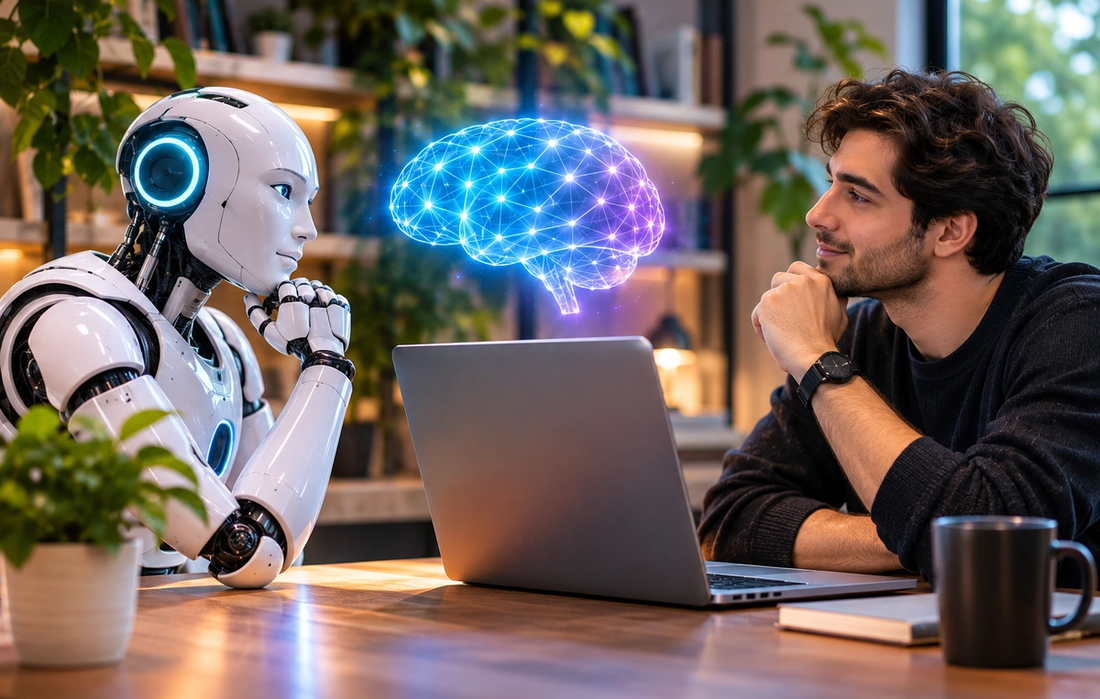
Artificial intelligence can sound much more mysterious than it really is. Terms like neural networks, machine learning, and large language models make it easy to imagine a machine that somehow thinks like a person. In reality, most modern AI works through a combination of enormous amounts of data, pattern recognition, and prediction. You don’t need equations to understand the basic idea.
AI Learns From Examples
Traditional software follows instructions written explicitly by programmers: if this happens, do that. Machine learning works differently. Instead of providing every rule, developers give a system many examples and allow it to identify patterns within them. Show an AI enough labeled pictures of cats and dogs, for example, and it can learn which visual patterns tend to distinguish one from the other. It isn’t memorizing a single definition of a cat. It is building a statistical model of what cats generally look like.
Generative AI Is Essentially Predicting What Comes Next
Tools that generate text work on a similar principle, but their training involves enormous collections of language. A large language model learns relationships between words, phrases, concepts, and structures. When you ask it a question, it generates an answer step by step by predicting what should come next based on your prompt, its learned patterns, and the conversation context. Image generators do something related with visual patterns, learning how concepts such as “mountain,” “sunset,” or “watercolor” tend to appear and relate to one another.
Why AI Can Seem Surprisingly Intelligent
Prediction sounds simple, but it becomes remarkably powerful at scale. Human language contains patterns of reasoning, explanation, storytelling, coding, argument, and problem-solving. By learning those patterns deeply enough, AI systems can perform tasks they were never individually programmed to complete. Modern systems may also use tools such as web search, code execution, or external databases, allowing them to work with information beyond what was learned during training.
AI Still Doesn’t Know Everything
The same mechanism that makes generative AI useful also creates its biggest weakness. An AI can produce an answer that sounds convincing even when the information is wrong. It generates responses based on learned relationships and available context rather than automatically verifying every statement against reality. This is why important facts, medical information, financial decisions, research, and other high-stakes answers still need reliable sources and human judgment.
The Simple Version
Strip away the technical language and AI becomes easier to understand. It learns patterns from huge amounts of information, uses those patterns to interpret what you ask, and predicts a useful response. The technology underneath can be extraordinarily complex, but the central idea isn’t: modern AI is extremely sophisticated pattern recognition and prediction operating at a scale humans have never had before.
Read More
The Shows Millennials Grew Up Watching (And Why They Still Hold Up)
Asaf Been|

The Websites That Defined the Early Internet (And Where They Went)
Roi Kad|

The Music That Shaped a Generation (And Why It Still Hits)
German Smolyar|

The Movies Every Older Millennial Can Quote Line for Line
Julian Doyle|

Why the Old Internet Feels So Nostalgic Now
Moran Sally|

The Cultural Shifts That Only Make Sense If You Were There
Drew Larson|